
Why Is My Hairline Thinning?
Why is my hairline thinning? Learn the common causes in women, what signs to watch for, and when expert diagnosis can help restore hair.
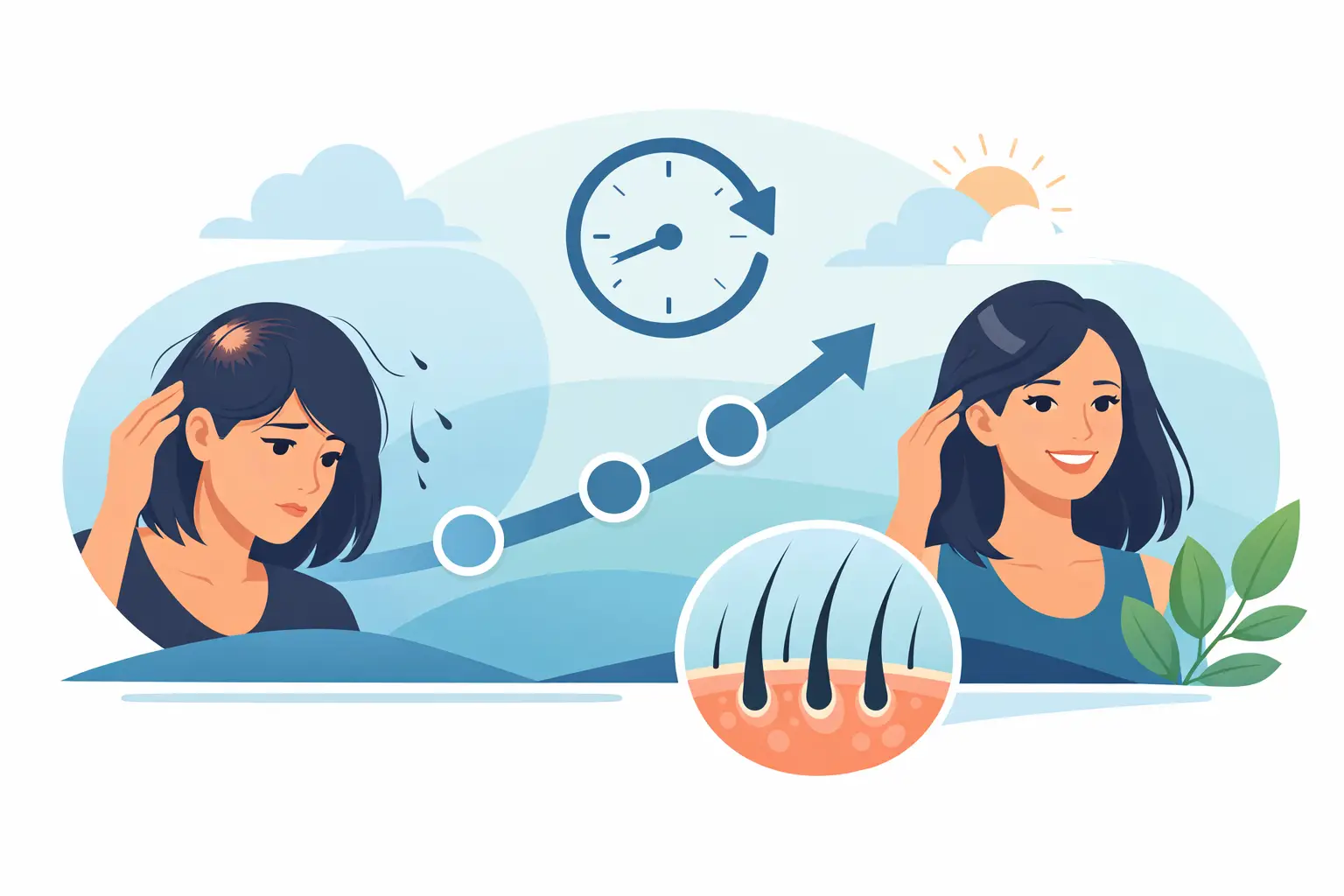
A brush full of hair after washing can feel alarming, especially when shedding seems to appear out of nowhere. The telogen effluvium recovery timeline is often longer and less linear than most women expect, which is why even normal regrowth can still feel unsettling. In many cases, the shedding improves – but not overnight, and not in exactly the same way for every woman.
Telogen effluvium is a form of diffuse hair shedding that happens when more hairs than usual shift into the resting phase of the hair cycle. This is often triggered by a stressor such as illness, surgery, rapid weight loss, hormonal changes, emotional stress, low iron, thyroid imbalance, or postpartum recovery. The key point is that the trigger happens first, and the shedding typically begins later.
For many women, increased shedding starts around six to twelve weeks after the event that disrupted the hair cycle. That delay can make the cause easy to miss. By the time the hair fall becomes obvious, the original trigger may feel far behind you.
Once shedding begins, the active hair fall phase often lasts for around two to four months. Some women notice a shorter course, while others shed for longer, particularly if the trigger is ongoing or if there is more than one cause involved. If the body is still under stress, the timeline can stretch.
Visible recovery usually takes more patience than the shedding phase itself. Even after hair fall starts to settle, the follicles need time to re-enter the growth phase and produce strands long enough to make a cosmetic difference. Early regrowth may appear as fine, short hairs around the hairline, part line, or crown. That can happen within a few months, but fuller density generally takes six to twelve months, and sometimes longer.
One of the most frustrating parts of telogen effluvium is that the condition is temporary, yet the emotional impact can feel anything but temporary. You may be told that the hair will grow back, but when your ponytail feels thinner or your scalp looks more visible, reassurance alone rarely feels sufficient.
Part of the disconnect comes from how hair growth works. Hair does not return all at once. Each follicle follows its own cycle, so regrowth is staggered. That means you can be recovering biologically while still feeling that your hair looks sparse.
Hair length also matters. If your hair is long, even healthy regrowth can take many months before it blends into the rest of your style. Women with longer hair often feel they are not recovering, when in reality new hairs are simply not yet long enough to contribute to visible volume.
There is also the question of baseline density. If your hair was already fine, or if you had underlying female pattern hair loss before the shedding episode, telogen effluvium may expose thinning that had gone unnoticed. In that situation, recovery may be partial rather than complete unless the underlying condition is addressed as well.
This is often the silent period. The stressor has happened, but major shedding may not have started yet. Many women do not connect the dots at this stage because nothing looks wrong.
This is commonly when the problem becomes visible. Hair may come out in the shower, on the pillow, or while brushing. The shedding can feel dramatic, but that does not automatically mean permanent damage. Telogen effluvium is defined more by the shift in the hair cycle than by scarring or follicle destruction.
If the trigger has been resolved, shedding may begin to slow. This is often the point when women expect immediate density to return, but that expectation usually leads to disappointment. Reduced shedding is progress, even if your hair still looks thin.
Early regrowth may become more noticeable. You may see shorter hairs standing up near the scalp or feel texture changes as new strands come in. If your scalp health is poor, or if deficiencies remain uncorrected, progress may be slower.
This is when many women start to see more visible improvement in volume and coverage. For some, especially after severe illness, nutritional depletion, or repeated triggers, full cosmetic recovery can take more than a year. The timeline is influenced by hair length, scalp condition, genetics, and whether there is another hair loss condition present.
Not every case follows the textbook pattern. When shedding lasts beyond six months, or when regrowth seems minimal, there is usually a reason worth investigating.
Low ferritin, vitamin D deficiency, thyroid dysfunction, and inadequate protein intake are common contributors. Hormonal shifts, especially postpartum or perimenopausal changes, can also prolong recovery. In some women, chronic stress keeps the body in a state that continues to disrupt the hair cycle.
Scalp inflammation matters too. If the scalp is irritated, oily, flaky, or sensitive, the environment for healthy regrowth may not be ideal. That does not mean the follicles cannot recover, but it does mean the treatment plan should go beyond simply waiting.
Another important factor is overlap with androgenetic alopecia, also called female pattern hair loss. Telogen effluvium can happen on top of this condition, and the two are often confused. If the shedding improves but the part line continues to widen, a more targeted approach may be needed.
The first priority is identifying and correcting the trigger where possible. That may include treating iron deficiency, improving nutritional intake, stabilizing thyroid levels, managing stress, or addressing hormone-related shifts. Without that step, treatment tends to be less effective.
The second priority is supporting the scalp and follicles during recovery. This may involve a personalized plan that includes medical-grade topical support, scalp therapy, supplementation when appropriate, and in some cases PRP or other regenerative treatments. The right approach depends on whether the issue is straightforward telogen effluvium or part of a broader hair loss picture.
Gentle hair care also matters, although it is not a cure on its own. Avoiding excessive heat, harsh chemical processing, and tight hairstyles can reduce additional stress on already fragile hair. Still, honesty matters here – shampoo changes alone do not reverse telogen effluvium.
At Dubai Hair Doctor, we often remind women that visible results come from precision, not guesswork. A tailored plan is especially important when shedding has become chronic, when confidence has taken a hit, or when previous treatments have not delivered clear improvement.
If shedding has lasted more than six months, if your part looks wider, if you notice patchy loss rather than diffuse shedding, or if your scalp is painful or inflamed, it is time for a proper assessment. The same is true if you have recovered from the original trigger but your hair density is not returning as expected.
A specialist evaluation helps determine whether this is true telogen effluvium, chronic telogen effluvium, female pattern hair loss, or a combination. That distinction changes the treatment plan. It also prevents wasted time on generic products that do not address the real cause.
For women balancing work, family, and a public-facing lifestyle, hair loss can feel deeply personal. It can affect how you style your hair, how often you appear on camera, and how confident you feel walking into a meeting. That is why reassurance should always be paired with real answers.
Recovery is not just physical. Many women become hyper-aware of every strand in the sink, every photo in bright light, and every comment about looking tired or stressed. Even when the prognosis is good, the waiting period can feel isolating.
This is where realistic guidance makes a difference. A truthful timeline helps set expectations and reduces panic when regrowth is slower than hoped. It also gives you a better sense of when patience is appropriate and when further investigation is justified.
If you are in the middle of telogen effluvium, the most helpful perspective is this: slowing shedding is the first win, new growth is the second, and visible density comes later. Hair recovery often asks for more patience than seems fair, but with the right diagnosis and individualized support, progress is absolutely possible.
Why is my hairline thinning? Learn the common causes in women, what signs to watch for, and when expert diagnosis can help restore hair.
Hair regrowth depends on the cause of hair loss. Learn what actually works, what delays results, and when expert treatment makes a difference.

Trichologist vs dermatologist hair loss – learn who treats what, when to seek each specialist, and how to choose the right care for lasting results.

PRP vs mesotherapy hair treatments – compare results, downtime, candidacy, and costs to choose the right option for thinning hair and scalp health.