

Postpartum Hair Loss Solutions That Put You First
Explore postpartum hair loss solutions that address shedding, scalp health and confidence, with personalised support for healthier regrowth after birth.
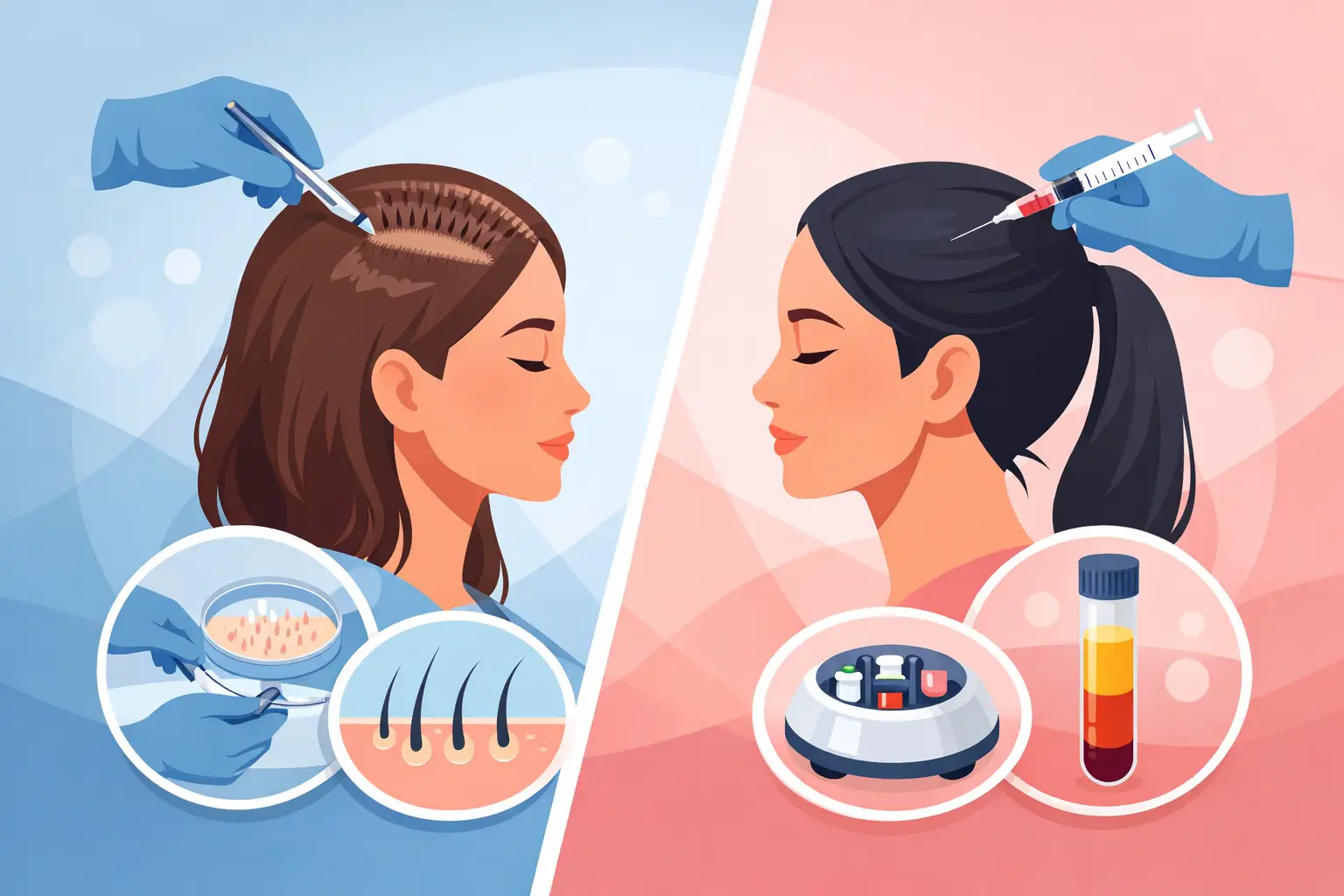
When women search for hair transplant vs PRP women, they are usually not comparing two equal treatments on paper. They are trying to answer a far more personal question: what will actually help my hair grow back, look fuller, and feel like me again? That answer depends on why the hair loss is happening, how advanced it is, and whether the follicles are weakened or already gone.
This is where many women get misled. PRP and hair transplant surgery are both used in hair restoration, but they solve different problems. One aims to stimulate struggling follicles. The other moves healthy follicles into areas where growth is no longer happening on its own. If you choose without a proper diagnosis, you can spend time and money on a treatment that was never designed for your condition.
PRP, or Platelet-Rich Plasma, is a non-surgical treatment. A small sample of your blood is processed to concentrate platelets, and that plasma is then injected into the scalp. The purpose is to support follicle function, improve the scalp environment, and encourage thicker, healthier growth in follicles that are still alive but underperforming.
A hair transplant is a surgical procedure. Follicles are taken from a donor area, usually where hair remains denser and more resistant to shedding, and placed into areas of visible thinning or hair loss. The goal is not to wake up weak follicles but to repopulate the area with new grafts that can grow in their new location.
That distinction matters. PRP cannot bring back follicles that are no longer viable. A transplant cannot stop the underlying process that is still causing active shedding in surrounding hair. In many women, the best plan is not one or the other forever. It may be the right treatment at the right stage, or a combination used strategically.
PRP tends to work best when there is still hair present, even if that hair has become finer, weaker, and less dense. Women with early thinning, diffuse hair loss, postpartum shedding, stress-related loss, or pattern thinning in its milder stages are often better candidates for PRP than surgery.
The reason is simple. PRP relies on the presence of functioning follicles. If your part is widening, your ponytail feels thinner, or your scalp is becoming more visible but there is still active hair in the area, PRP may help strengthen what remains. It can improve thickness, reduce shedding in some cases, and support overall scalp health.
It is also attractive to women who want minimal downtime. There are no incisions, no graft placement, and no long surgical recovery. Most patients return to normal routines quickly, which matters for busy professionals and anyone who values privacy.
That said, PRP is not a one-time fix. It usually requires a series of sessions followed by maintenance. Results are gradual, and expectations need to be realistic. You may see improvement in density and hair quality, but PRP does not create the same kind of dramatic coverage that transplant surgery can provide in the right candidate.
A hair transplant becomes more relevant when there are areas where follicles are no longer producing meaningful growth. This may happen around the hairline, temples, brows in some cases, or in localized zones of traction damage or scarring, depending on the diagnosis.
For women, candidacy is more nuanced than it is for men. Female hair loss often appears as diffuse thinning across the scalp rather than a clearly defined bald patch. If the donor area is also thinning, surgery may not be the best choice. A transplant depends on having strong donor hair that can be safely harvested without creating visible loss elsewhere.
The women who tend to do best with transplantation are those with stable, localized hair loss patterns and a healthy donor supply. In these cases, a transplant can restore shape, density, and framing in a way non-surgical treatments cannot. This is especially relevant when the concern is a receding hairline, temple loss, or a long-standing area that has not responded to medical therapy.
Still, surgery is not a shortcut. It involves planning, recovery, and patience while the grafts settle and begin growing. It also does not replace the need to manage any ongoing scalp or hair loss condition. If active thinning continues untreated, transplanted hair may grow well while the native hair around it keeps weakening.
The better treatment is the one that matches the biology of your hair loss.
PRP often gives better results when the goal is preservation and thickening. If your follicles are miniaturizing but still present, PRP can be a valuable part of treatment. Women often appreciate that it works with existing hair, feels less invasive, and can improve overall hair quality.
A hair transplant gives better results when the goal is restoration in an area that no longer has enough viable follicles. If there is a true gap in density, surgery can provide coverage that PRP simply cannot generate on its own.
This is why before-and-after expectations must be handled carefully. PRP results are usually measured in improved density, reduced shedding, better texture, and healthier growth over time. Transplant results are measured in graft survival, visible filling of sparse areas, and reshaping of the hairline or affected zone. They are different treatment outcomes, not just different ways to reach the same endpoint.
For many women, practicality matters just as much as medical suitability.
PRP typically involves mild discomfort from injections and little interruption to your routine. You may have scalp tenderness for a short time, but recovery is relatively easy. Because multiple sessions are usually needed, the cost adds up over time rather than all at once.
A hair transplant involves more upfront commitment. There may be swelling, tenderness, scabbing, and a more noticeable recovery period. The financial investment is also generally higher at the start. However, because the transplanted follicles are moved permanently, the long-term value can be strong for the right candidate.
Neither option should be judged by price alone. A less expensive treatment that does not address the real cause of loss is costly in a different way. It delays meaningful progress.
Female hair loss is rarely as straightforward as it appears online. Hormonal changes, iron deficiency, thyroid imbalance, inflammation, traction, genetics, stress, autoimmune conditions, and scalp disorders can all affect treatment success. Two women with similar-looking thinning may need very different plans.
This is why a specialist evaluation matters. A proper consultation should look at scalp health, medical history, pattern of loss, shedding timeline, family history, and whether the follicles are miniaturized, dormant, or no longer functioning. Without that level of assessment, choosing between PRP and transplant is guesswork.
At Dubai Hair Doctor, this is exactly where individualized care changes outcomes. The focus is not on pushing one procedure, but on identifying the cause, understanding your goals, and recommending the treatment path that gives your hair the best chance of visible improvement.
Yes, and in many cases they should.
PRP can support scalp health before surgery, help strengthen surrounding native hair, and be used after a transplant as part of an overall restoration plan. It is not a replacement for surgery when follicles are gone, but it can complement a transplant by improving the condition of existing hair and helping maintain density around the grafted area.
This combined approach is often ideal for women who have both localized loss and generalized thinning. Surgery can restore the most affected area, while PRP helps support the rest of the scalp. That kind of planning tends to produce more natural, balanced results than relying on one treatment alone.
If your hair is thinning and the follicles are still active, PRP may be the more appropriate first step. If you have a stable area where growth is no longer happening and your donor hair is strong, a transplant may offer more meaningful change. If both issues are present, a tailored combination may be the smartest path.
What matters most is not choosing the treatment that sounds more advanced. It is choosing the one that matches your diagnosis, respects your timeline, and supports your confidence in a realistic way.
Hair restoration for women should never feel like a gamble. With the right assessment, the right expectations, and a plan built around your specific scalp and hair history, you can move forward with clarity instead of guesswork.
Explore postpartum hair loss solutions that address shedding, scalp health and confidence, with personalised support for healthier regrowth after birth.
What is the best female hair loss treatment? Personalised diagnosis, scalp care and proven options can help restore density and confidence over time.

Learn how to diagnose female hair thinning with a specialist assessment of shedding, scalp health, hormones and lifestyle, then choose focused care today.
Menopause related hair thinning can feel distressing. Learn why it happens, what a proper assessment involves and which treatments may help restore density.