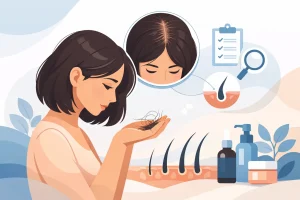
Perimenopause hair loss solutions start with the right diagnosis. Learn what helps, what to avoid, and when specialist treatment makes sense.
Hair that suddenly feels finer at the temples, thinner through the part line, or weaker in the shower can be deeply unsettling – especially when the rest of your routine has not changed. For many women, perimenopause hair loss solutions become a priority long before menopause officially begins. The shift can feel abrupt, but the biology behind it is usually gradual, layered, and treatable.
Why hair changes during perimenopause
Perimenopause is the transition leading up to menopause, and hormone fluctuations are the main reason hair often starts behaving differently. Estrogen and progesterone help support the growth phase of the hair cycle. As those hormones become less stable, hair may spend less time growing and more time shedding. At the same time, the relative effect of androgens can become more noticeable, which may contribute to thinning around the crown, widening of the part, and reduced density overall.
That is only part of the picture. Women in perimenopause may also be dealing with low iron, vitamin D deficiency, thyroid imbalance, stress, poor sleep, scalp inflammation, or a genetic tendency toward female pattern hair loss. This is why two women with similar symptoms can need very different treatment plans. Hair thinning in this stage is common, but it should never be brushed off as something you simply have to accept.
The best perimenopause hair loss solutions start with diagnosis
One of the biggest mistakes women make is treating hair loss as a cosmetic issue alone. New shampoos, supplements, and social media recommendations can be tempting, but they often delay proper diagnosis. If your hair is shedding more than usual, your ponytail feels smaller, or your scalp is becoming more visible, the first step is identifying the exact driver.
A specialist evaluation should look at your hair history, family history, recent health changes, scalp condition, and pattern of thinning. In many cases, blood work is also useful to assess ferritin, vitamin D, thyroid function, and other contributing factors. Scalp assessment matters too. A dry, irritated, or inflamed scalp can quietly worsen shedding and interfere with healthy regrowth.
This is where personalized care makes a real difference. At Dubai Hair Doctor, women are assessed for both the visible signs of thinning and the underlying triggers that may be accelerating it. That combination is often what turns frustration into a treatment plan with a clear direction.
What actually helps with perimenopausal hair thinning
The right treatment depends on the cause, severity, and how long the thinning has been happening. Some women respond well to early intervention with topical or medical support. Others need a broader plan that addresses scalp health, internal imbalances, and active follicle stimulation.
Topical treatment can help, but it is not the whole answer
For some women, topical minoxidil remains one of the most evidence-based options for female pattern thinning. It can help extend the growth phase and improve density over time. The trade-off is that it requires consistency, and some women experience scalp irritation or increased shedding in the early weeks before improvement begins. It is also not the right fit for every scalp type.
If inflammation, sensitivity, or buildup is present, starting with scalp recovery may be more appropriate before adding stronger hair growth treatments. A compromised scalp environment can make any treatment less effective.
Scalp health is often underestimated
Healthy hair does not grow well from an unhealthy scalp. During perimenopause, some women notice increased dryness, itching, oil imbalance, or tenderness. These changes can signal barrier disruption or low-grade inflammation, both of which can affect hair quality and retention.
Targeted scalp therapy can improve the environment around the follicle by reducing irritation, removing buildup, and supporting circulation. This is not just about comfort. In many cases, restoring scalp health is a practical part of restoring stronger hair.
PRP can be valuable for the right candidate
Platelet-Rich Plasma, or PRP, is often considered when women want a non-surgical treatment with a regenerative focus. PRP uses your own platelets to deliver growth factors into the scalp, with the goal of supporting follicle function and improving hair density.
It is not an overnight fix, and results vary depending on how advanced the hair loss is and whether there are untreated internal factors. Still, for women in the earlier to moderate stages of thinning, PRP can be a strong option within a broader treatment plan. The key is realistic expectations and proper case selection.
Correcting internal triggers matters
If ferritin is low, thyroid levels are off, stress is high, or nutrition is compromised, hair often struggles no matter what is applied to the scalp. That is why meaningful perimenopause hair loss solutions often include coordination between hair-focused treatment and general medical support.
This does not mean every woman needs a long list of supplements. In fact, taking random supplements can be unhelpful or even counterproductive. What works is targeted correction based on real findings. If there is a deficiency, address it. If there is hormonal sensitivity, factor it into the plan. If the issue is mostly genetic thinning revealed by hormonal change, treat that directly rather than chasing unrelated causes.
What to avoid when your hair starts thinning
When hair loss affects confidence, it is understandable to want a quick answer. Unfortunately, this is where many women lose time and money. Expensive oils, heavy extensions, harsh scalp scrubs, and trend-driven supplements can all create false hope.
Extensions and tight styling may hide the problem temporarily, but they can increase traction and make fragile hair even weaker. Overloading the scalp with multiple actives can also backfire, especially if the skin is already sensitive. Even some treatments marketed as natural can cause irritation or buildup.
There is also the risk of waiting too long. Hair follicles respond best when treatment begins early. If thinning has been progressing for months or years, a specialist review becomes more urgent, not less.
When hair loss may be more than perimenopause
Not every case of thinning in your forties is caused by perimenopause alone. Sudden heavy shedding after illness, rapid patchy loss, burning or scaling of the scalp, or eyebrow thinning can point to a different issue. Telogen effluvium, alopecia areata, scarring alopecia, and thyroid-related hair loss can all overlap with this life stage.
That is why a vague label is rarely enough. Being told it is just hormones may feel dismissive when your hair is clearly changing. A proper diagnosis gives you options, and options are what restore a sense of control.
A realistic timeline for seeing results
Hair recovery takes patience. Most effective treatments need at least three to six months before you can fairly judge early progress, and fuller improvement often takes longer. That can feel frustrating, but it reflects the biology of the hair cycle rather than treatment failure.
What matters is whether the plan is reducing shedding, stabilizing the pattern, and creating signs of healthier regrowth over time. Sometimes the first win is simply seeing less hair on the brush or less scalp showing under bright light. Those small shifts often come before more visible density.
The emotional side deserves attention too
Hair loss during perimenopause is not superficial. For many women, it affects confidence, social ease, and how they feel when they look in the mirror. It can make a healthy, successful woman feel suddenly unfamiliar to herself. That emotional impact is real, and it deserves the same seriousness as the physical symptoms.
This is one reason specialist care matters. The right clinic does not minimize what you are experiencing or push a one-size-fits-all package. It explains what is happening, what can improve, and what is realistic for your stage of hair loss. Honest guidance is often as valuable as the treatment itself.
If your hair has changed and you have been told to wait it out, trust what you are seeing. The most effective perimenopause hair loss solutions are rarely about one miracle product. They come from a clear diagnosis, a tailored plan, and early, science-backed support that helps you protect both your hair and your confidence.