
Hair Transplant vs PRP for Women
Hair transplant vs PRP for women – compare results, downtime, cost, and candidacy to choose the right hair restoration treatment with expert guidance.
When your part looks wider, your ponytail feels thinner, and shedding starts to affect how you get ready each morning, the question becomes very practical: in prp vs mesotherapy hair treatment, which one is actually worth your time and investment? Both are commonly used for hair thinning, but they work differently, suit different scalp conditions, and do not deliver the same type of result for every woman.
For many patients, the real frustration is not a lack of options. It is having too many options presented as if they are interchangeable. They are not. A thoughtful treatment plan starts with the cause of thinning, the condition of the scalp, the stage of hair loss, and how your follicles are responding right now.
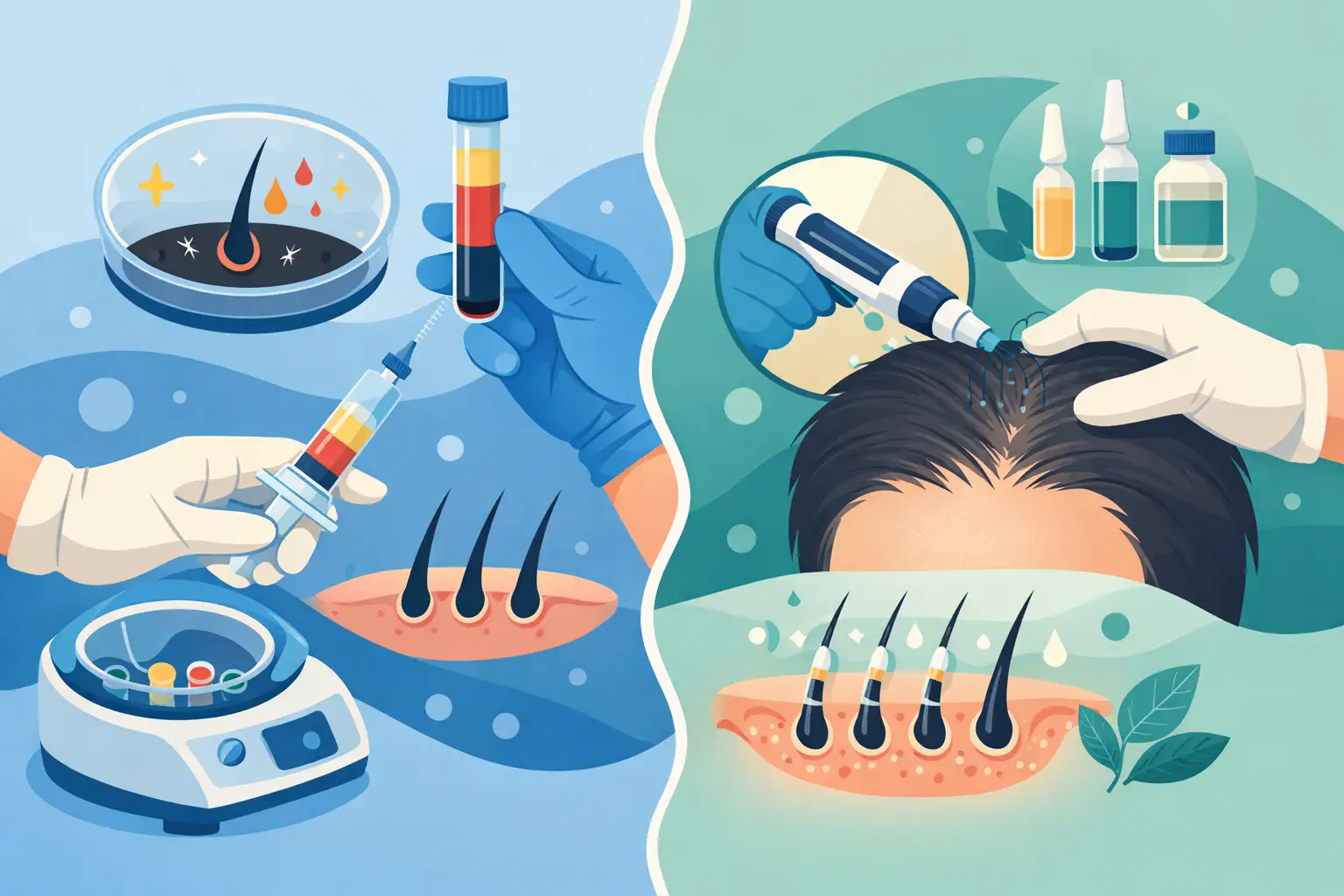
PRP stands for platelet-rich plasma. It uses a small sample of your own blood, processed to concentrate platelets and growth factors, then injected into areas of thinning. The goal is to stimulate weakened follicles, support the hair growth cycle, and improve hair density over time.
Mesotherapy for hair usually involves a customized blend of ingredients delivered into the scalp through microinjections. Depending on the clinic and the patient, that formula may include vitamins, amino acids, minerals, peptides, hyaluronic acid, or other supportive compounds intended to nourish the scalp environment and improve hair quality.
That difference matters. PRP is a regenerative treatment based on your body’s own biological signals. Mesotherapy is more of a targeted delivery method for scalp and follicle support. One is not automatically better than the other. The better option depends on what your hair and scalp need.
PRP is often recommended when the focus is follicle stimulation and hair miniaturization. This is especially relevant for women with early to moderate thinning, reduced density around the part line, or ongoing shedding where follicles are still alive but underperforming.
The appeal of PRP is that it is autologous, meaning it comes from your own blood. For women who prefer a more natural, medically grounded treatment with fewer additive ingredients, that can feel reassuring. It is also one reason PRP is often chosen by patients who want a treatment with a strong science-based reputation in hair restoration settings.
PRP may be a good fit if your scalp is generally healthy but your hair has become finer, weaker, or slower to regrow. It is also commonly used to support recovery and improve outcomes after hair transplantation, or as part of a broader program that includes medical management of female pattern hair loss.
That said, PRP is not magic. Results vary based on platelet quality, injection technique, treatment intervals, and the reason you are losing hair in the first place. If there is active inflammation, severe nutritional deficiency, hormonal disruption, or scarring hair loss, PRP alone may not be enough.
Mesotherapy can be appealing when the scalp itself needs attention, not just the follicles. If you have dryness, poor scalp condition, mild irritation, or hair that feels weak and dull in addition to thinning, mesotherapy may help improve the overall environment in which hair grows.
It can also be useful for women who are not ideal candidates for PRP, including those who strongly prefer not to have a blood draw. In some cases, mesotherapy is selected because the treatment can be tailored more specifically to current scalp needs. That flexibility is one of its strengths.
Still, not all mesotherapy is equal. The formula matters, the diagnosis matters, and the practitioner matters. A generic cocktail used without proper scalp assessment is unlikely to give the kind of visible improvement most patients are hoping for. Mesotherapy is best viewed as a customized supportive treatment, not a universal answer to every type of hair loss.
This is where honest guidance matters most. In the prp vs mesotherapy hair discussion, better results depend on what you mean by better.
If the goal is stronger stimulation of dormant or miniaturizing follicles, PRP often has the edge. It is generally considered the more regenerative option and is frequently chosen for patients who want to improve density, reduce shedding, and support thicker regrowth over a course of sessions.
If the goal is improving scalp hydration, nutrient delivery, hair shaft quality, and overall scalp support, mesotherapy may be the more appropriate place to start. Some patients notice their hair feels healthier and their scalp more balanced even before they see meaningful changes in density.
For many women, the most effective plan is not a strict choice between the two. It is sequencing or combining treatments based on diagnosis. A specialist may recommend PRP for follicle stimulation and mesotherapy for scalp optimization, or use one approach first and reassess your response before adding the other.
Both treatments are minimally invasive, but neither is exactly a spa treatment. PRP involves a blood draw followed by scalp injections. Mesotherapy also uses scalp injections, though the contents differ. With either option, you may have temporary tenderness, pinpoint redness, mild swelling, or a sore scalp for a day or two.
Most patients return to normal activities quickly. The bigger consideration is consistency. Hair treatments work on a biological timeline, not an overnight cosmetic one. You usually need a series of sessions, then maintenance, and visible improvement often takes a few months.
That can be emotionally challenging when hair loss is already affecting your confidence. Patients often want a clear yes or no answer after one treatment. Hair restoration rarely works that way. Progress is usually gradual: less shedding first, then stronger texture, then improvement in density if the follicles are capable of responding.
PRP is often priced higher than mesotherapy because it involves blood processing equipment and a more specialized regenerative protocol. Mesotherapy may be less expensive per session, but the total value depends on the quality of the formulation and whether it is actually the right treatment for your diagnosis.
The cheapest treatment becomes expensive if it delays proper care. The most premium treatment can also disappoint if it is used on the wrong patient. This is why a personalized consultation matters more than comparing menu prices alone.
A woman with telogen effluvium after stress, a woman with iron deficiency, and a woman with androgen-related thinning may all describe the problem as hair loss. Their treatment plans should not look identical.
If your shedding is sudden, severe, patchy, painful, or associated with itching and burning, do not self-select a treatment based on trends. These signs can point to conditions that need proper diagnosis before any injection therapy is considered.
The same applies if you have a long history of thinning that has not responded to products, supplements, or salon-led treatments. Persistent hair loss deserves a scalp and hair assessment grounded in trichology, not trial and error.
This is especially important for women, whose hair loss is often dismissed, oversimplified, or treated too late. Hormones, nutritional status, stress, scalp inflammation, styling practices, and genetics can all overlap. The best outcomes come from understanding that full picture.
A responsible recommendation is based on more than the treatment itself. It should take into account your pattern of thinning, how long it has been happening, whether your scalp is inflamed, how active the shedding is, and what your goals are.
At a specialist clinic such as Dubai Hair Doctor, the conversation is not simply PRP or mesotherapy. It is why you are losing hair, what can realistically be improved, and what protocol gives you the best chance of visible progress while protecting long-term scalp health.
That may include one treatment, a combination approach, or a different route entirely. Sometimes the most honest answer is that internal drivers need attention first. Good care is not about selling the fastest procedure. It is about choosing the plan that matches your biology.
Choose PRP if your main concern is follicle stimulation, early to moderate thinning, and improving density with a regenerative approach. Choose mesotherapy if scalp support, nourishment, or a customized topical injection protocol makes more sense for your condition. Consider both if your hair loss picture is mixed and your specialist believes the treatments can play complementary roles.
The right decision should leave you feeling informed, not pressured. Hair loss is personal, and for many women it touches confidence long before anyone else notices the change. You deserve a treatment plan built around diagnosis, honesty, and real expectations. The best next step is not chasing the most popular option – it is choosing the one that fits your scalp, your follicles, and your future results.
Hair transplant vs PRP for women – compare results, downtime, cost, and candidacy to choose the right hair restoration treatment with expert guidance.

Iron deficiency hair loss female concerns are common. Learn signs, causes, testing, and treatment options to support fuller, healthier hair.
Stress related hair loss in women can be temporary, but it needs the right diagnosis. Learn causes, signs, and treatment options.

Perimenopause hair loss solutions start with the right diagnosis. Learn what helps, what to avoid, and when specialist treatment makes sense.